
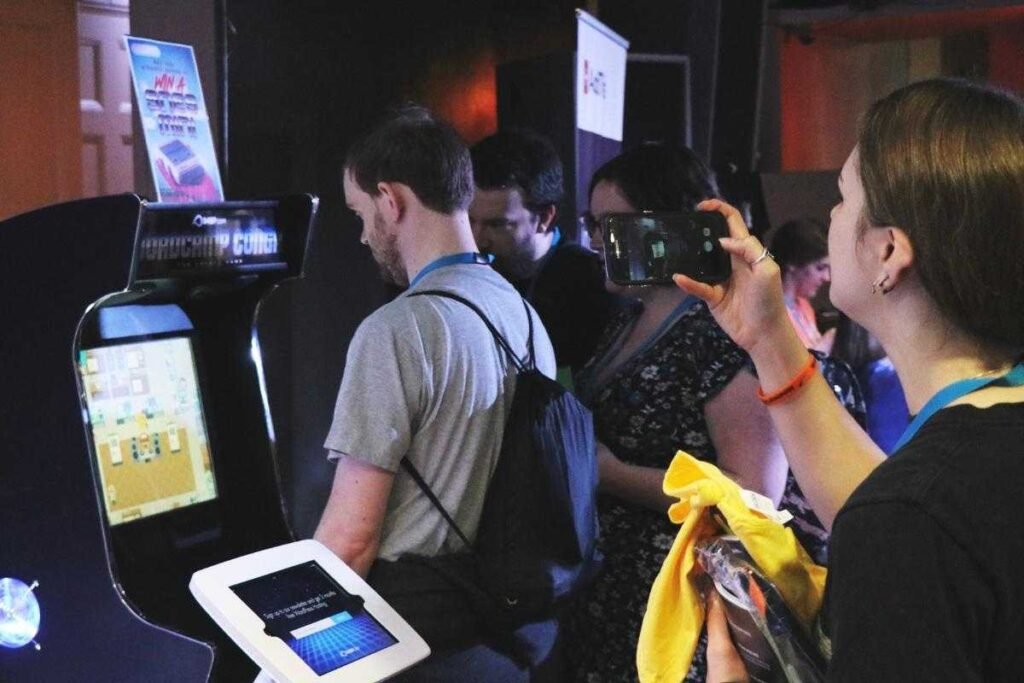
Most trade show games don’t fail because they’re bad.
They fail because no one notices them.
On a crowded expo floor, your game has about two seconds to earn a glance—and maybe another two to earn a stop. That’s it.
Based on what actually works at real booths, here are 11 design elements that make trade show games impossible to ignore.
1. Movement That’s Visible From Far Away
Static screens disappear in busy halls.
High-performing games always have:
- Constant motion
- Large animated elements
- Something changing even when idle
If your screen looks frozen from 10–15 feet away, it won’t pull anyone in.
2. Bold Contrast (Not Subtle Design)
Subtle design works on websites.
It dies at trade shows.
Games that get noticed use:
- High contrast colors
- Clear separation between background and action
- Big, readable elements
This isn’t the place for minimalist elegance.
3. One Clear Visual Focus
Too many games try to show everything at once.
The best ones guide the eye:
- One main action
- One obvious goal
- No visual confusion
If people don’t instantly know where to look, they keep walking.
4. An Inviting Idle Screen
When no one is playing, the game should still be working.
Strong idle states:
- Show gameplay previews
- Loop animations
- Invite interaction (“Tap to Play”)
An empty or paused screen kills curiosity.
5. Big, Readable Text From a Distance
If text can’t be read from a few steps away, it doesn’t exist.
High-performing games:
- Use large fonts
- Keep text minimal
- Avoid long sentences
Trade show reading is skimming—at best.
6. Immediate Feedback on Interaction
The moment someone touches the screen or presses a button, something should happen.
Sound. Motion. Color. Reaction.
Instant feedback reassures players that:
- They did the right thing
- The game is responsive
- It’s safe to continue
Delay creates hesitation.
7. A Visually Obvious Start Point
People hesitate when they’re unsure.
Games that perform well clearly show:
- Where to tap
- How to begin
- That interaction is welcome
The simpler the start, the faster the engagement.
8. Visible Progress or Countdown
People are more likely to start something when they know it will end soon.
Progress bars, timers, or stages tell players:
“This won’t take long.”
That single reassurance increases participation dramatically.
9. A Satisfying End Screen
The end moment matters more than most people think.
Great games end with:
- A score
- A result
- A clear outcome
This is the moment people react, laugh, or ask questions—don’t rush past it.
10. Subtle, Not Aggressive Branding
When branding dominates, fun disappears.
The most effective games:
- Let gameplay lead
- Place branding around the experience
- Reinforce the brand at the end
If the game feels like an ad, people won’t play.
11. Designed for Spectators, Not Just Players
This is often overlooked.
Games that attract crowds are fun to watch, not just play.
They show:
- Clear action
- Visible reactions
- Easy-to-understand progress
Spectators turn into players. Players turn into conversations.
Final Thought
Trade show games don’t compete with other games.
They compete with:
- Noise
- Movement
- Fatigue
- Distraction
Design elements that work in studios or on websites often fail on the show floor. The ones that win are loud, clear, and instantly readable.